The YOUTH MOVE TA CENTER
RESOURCES
Check out these resources created by the
Youth MOVE Peer Center
Issue Briefs
Our issue briefs take on a contemporary topic surrounding youth engagement and peer support and provides a deeper conversation with resources.
Implementation Guides
Our Implementation Guides provide an in-depth look at a variety of youth engagement and peer support topics.
Webinars
The Youth MOVE Peer Center delivers a variety of training and education opportunities, these webinars have been recorded and are available on demand! Check out the archive below.
Newsletters
Be sure to sign up for our newsletter to get them directly to your email. Check out the archive below.
Check Out Our NEW Resources!
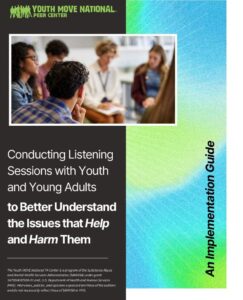
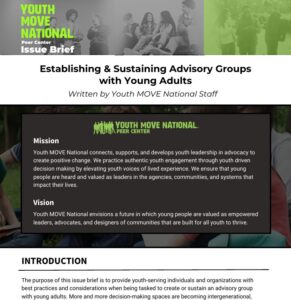
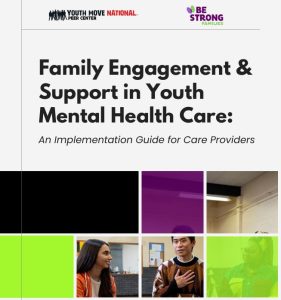
Issue Briefs
Implementation Guides
Recruiting & Retaining Youth Peer Support Specialists Implementation Guide
Webinar Recordings
Supporting Youth in Storytelling: Strategic Sharing Foundations –
Watch Webinar >>
Economic Independence for Youth & Young Adults –
Navigating the world of money and finances can feel overwhelming and confusing! The truth is managing money can be complex, but it doesn’t have to be impossible to understand things like bank accounts or credit reports.
Our Economic Independence for Youth & Young Adults training event aims to empower youth and young adults, especially those with system involvement, by equipping them with the essential tools and resources to prepare for financial independence!
Watch Webinar >>
Psych Advance Directives for Youth and Young Adults Webinar –
A Psychiatric Advance Directive (PAD) is a legal document that details preferences for future mental health treatment, services, and supports. This webinar will present the core elements of a PAD, and the role and benefits of Peer Specialists facilitating and supporting their development. Learn why these documents are important for young people and how a PAD can support one’s recovery and interactions with the mental health system. Having a PAD can have positive impacts on one’s mental health and the types of crisis services received. PAD’s can be a helpful tool to ensure that your wishes are followed no matter what stage of life you are in- but particularly for a young person this is a pathway for self-direction and self-advocacy for one’s treatment options. This presentation was led on May 17, 2023 by peer specialists of whom are subject matter experts in peer facilitated PAD’s and youth peer support.
Watch Webinar >>
Online Courses

Own Your Story & Be a Resource for Change:
Youth MOVE National’s Youth Peer Support 101 course.
This course is meant to guide you through an experience that shows that lived experience can be used in a variety of meaningful ways, including creating career pathways! This two-part learning series is designed to show you that your story is powerful and can be used to make a change in the world!

Trauma-Informed Youth Peer Support
Developed By Pacific Southwest MHTTC & YMN Peer Center
This training module will assist participants in understanding the foundations of trauma-informed care, including its principles and philosophy, demonstrate why this approach to care is important, and present strategies for incorporating trauma-informed practices throughout youth peer support services. It is critical for peer providers to understand how trauma may impact the youth and young adults they serve. This training will provide concrete examples of what trauma-informed practice looks like in action and how to apply this philosophy within peer relationships. The online course was collaboratively developed and produced by the Pacific Southwest MHTTC and Youth MOVE National.
Youth Program Startup Guide
Setting up an effective youth voice & lived-experience program.
As the youth movement continues to expand, there has been an increased interest in youth voice and youth engagement strategies nationwide. Adult systems often provide services which do not align with the clinical profiles of youth and young adults, negatively impacting young peoples’ ability to engage in mental health care (Rickwood, Deane, & Wilson, 2007; Pottick, Warner, Stoep, & Knight, 2013). When experiencing personal challenges, youth and young adults tend to seek informal supports such as friends, family, or other significant adults, rather than from traditional mental health professionals (Rickwood, et al., 2007). Because existing services and systems may not adequately attract, engage, and serve young people, there has been an emergence of youth-run programs and organizations
Newsletter Archive